

Human Body Activities for Kids: A Complete Homeschool Unit Study
|
|
Have you ever noticed that kids are completely fascinated by the human body?
They'll compare the size of their hands, race each other just to feel their hearts pounding, wiggle loose teeth, ask why they get goosebumps, and somehow turn every scraped knee into a dramatic story. The human body is something they experience every single day, which makes it one of the most exciting science topics to explore together.
When I set out to create our Explore the Human Body Unit Study, I wanted it to feel less like a science textbook and more like an adventure. I wanted kids to build, experiment, create, move, and ask questions. Most of all, I wanted them to walk away saying, "That was so cool!"
After working through the entire unit with my own kids, I can honestly say it became one of our favorite Knowledge Crates we've ever created!
Table of Contents
When people search for human body activities for kids, they're usually hoping to find something more exciting than worksheets and vocabulary lists.
That's exactly what we wanted, too.
This unit is packed with over 40 hands-on human body activities for kids covering everything from cells and body systems to muscles, bones, the heart, lungs, digestion, the brain, and the five senses. Along the way, children read engaging books, complete science experiments, create art, keep a scientist's notebook, and build models they can actually interact with.
Everything arrives ready to use, including:
It's designed primarily for upper elementary-aged homeschoolers, but we found it worked wonderfully as a family unit. My 7- and 10-year-olds could complete every activity independently or with just a little guidance, while younger siblings naturally joined in with many of the projects.
In fact, one of our neighbor friends ended up participating in a good portion of the unit, too. That's one of my favorite things about hands-on learning—it has a way of pulling everyone into the fun.
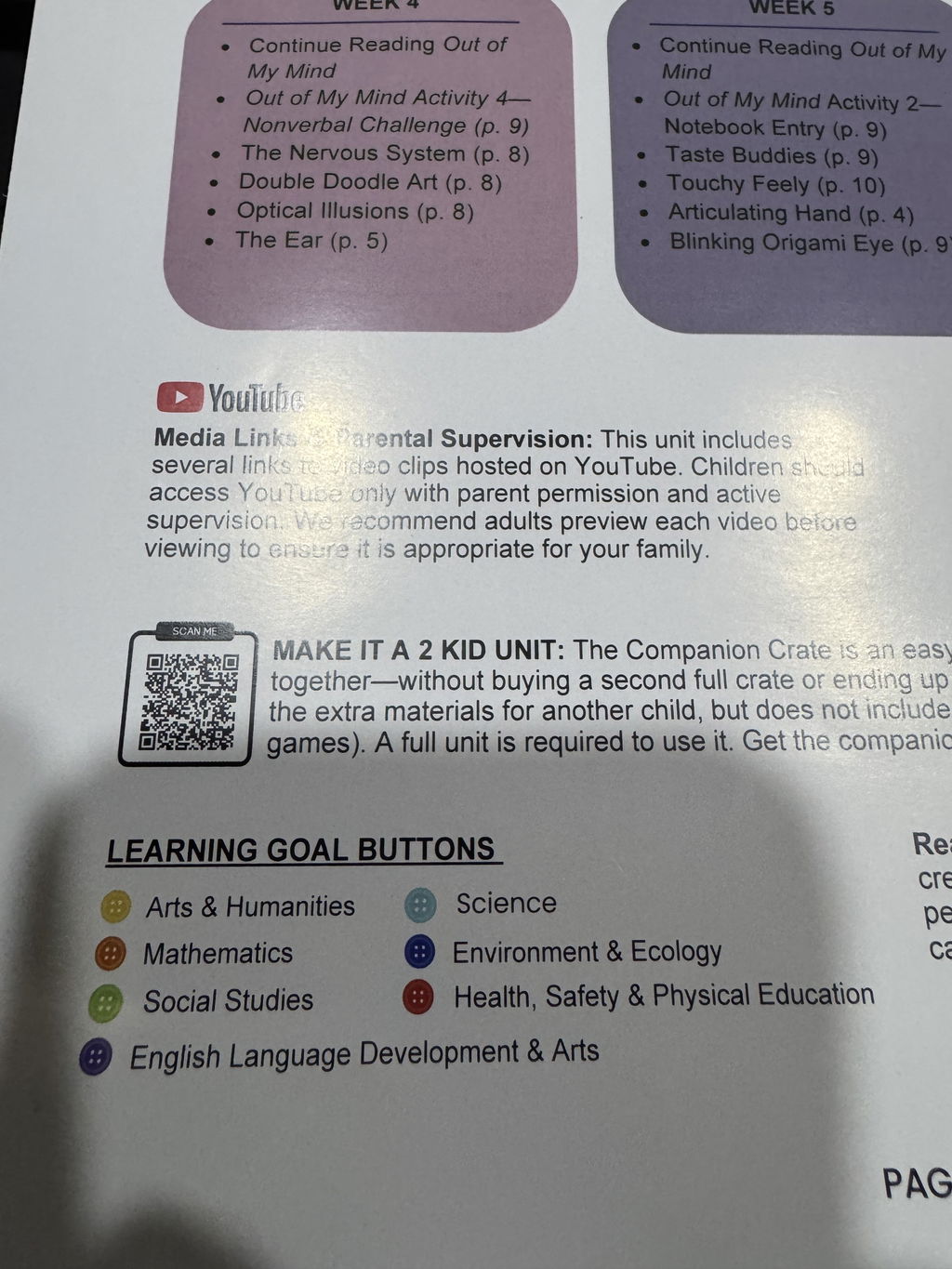
One of the very first human body activities for kids in the unit is creating their Human Body Notebook.
Throughout the unit, children use it to sketch diagrams, record observations, answer reflection questions, and document the experiments they complete. Instead of scattered worksheets, everything they learn is collected in one place, creating a keepsake they can look back on long after the unit is finished.
By the end, it's filled with labeled drawings, personal discoveries, and evidence of just how much they've learned!
If I had to identify one activity everyone kept coming back to, it would be the Squishy Human Body.
In our house, this one definitely brought out some strong reactions—my son was completely grossed out by it and happily let his little sister take on most of the “operating.” She, on the other hand, thought it was gross in the best possible way. She actually put it together, took it apart, and immediately did it all over again… and then asked to do it again the next day.
Kids absolutely love removing each organ, figuring out where it belongs, and following a slice of pizza as it travels through the digestive system and interacts with different organs along the way.
What really makes this set stand out is how sturdy it is—it's a SmartLab Toys product, and it holds up beautifully to repeated use (and enthusiastic little hands). The included book is also fantastic: it walks kids step-by-step through the body using the pizza story, and it’s incredibly kid-friendly while still being packed with real science facts.
Rather than simply memorizing body parts from a diagram, they're holding the organs in their hands, putting them back together, and constantly making connections as they learn about each body system throughout the unit.
It quickly became the centerpiece of our studies, and we found ourselves bringing it back out again and again whenever we learned about a new organ!
The science experiments are where this homeschool unit really shines.
Instead of simply reading about anatomy, children become scientists, artists, and investigators. Every experiment encourages them to ask questions, make predictions, test ideas, and discover how their own bodies work.
One of the human body activities for kids I KNEW I had to include in this unit was building a pumping heart model. Using simple materials, kids create a heart that pumps colored water through straws, making it easy to visualize how blood moves through the body.
It's one thing to read about the circulatory system.
It's another thing entirely to watch your own model pump "blood" before your eyes.
The articulating hand is another of the human body activities for kids that shines!
By constructing tendons and fingers using straws and string, kids can actually pull the strings and watch each finger bend, making it incredibly easy to understand how tendons control movement.
This activity was a huge hit in our house. Once it was finished, everyone wanted to try making the fingers move.
The Moving Muscles activity gives kids a chance to build their own working arm model using simple materials.
As they watch the arm bend and , they begin to understand how muscles, tendons, and bones all work together every time we move.
It's one of those projects that feels equal parts engineering challenge and science lesson.
This was hands-down my family's FAVORITE activity out of the whole unit study.
The Infection Simulation starts out innocently enough. One cup is “infected” with vinegar, while all the others contain plain water.
Everyone simply follows the instructions, trading cups back and forth as they interact with different people in their “community,” unknowingly passing the liquid along as they go.
Then comes the reveal.
At the end, baking soda is added to each cup—and the reaction shows exactly where the “infection” has spread, as only the cups that received vinegar begin to foam. The look on the kids’ faces when they realized how quickly the “germs” had spread was priceless! It sparked one of the best conversations we had during the entire unit about handwashing, staying home when we’re sick, and how illnesses travel through families, classrooms, and communities.
Lorem ipsum dolor sit amet consectetur adipisicing elit. Illum neque eaque, autem sit soluta, voluptatum libero magnam tempore ullam at harum vel, ad reprehenderit, nemo veniam quas in voluptas hic. Lorem ipsum dolor, sit amet consectetur adipisicing elit. Natus id officia omnis suscipit aut architecto repellat a quia eaque reiciendis blanditiis perferendis hic, nihil, mollitia. Iste velit aperiam, numquam dolorem.
Even though this is a science unit, one thing you know about Knowledge Crates by now is we are allllll about cross-curricular learning, connecting science, social studies, handwriting, movement, language arts, and ... ART!
The art projects we chose reinforce anatomy concepts while giving kids a chance to slow down, be creative, and make something they're genuinely proud of.
Our X-Ray Art projects turned out so well! The glowing chalk effect makes them look surprisingly realistic.
The Blinking Origami Eye was another favorite. Folding it was fun, but watching it actually blink once it was finished was the real magic.
And Double Doodle Art, where kids draw with both hands at the same time, was equal parts challenging, funny, and surprisingly relaxing.
These projects add a completely different pace to the unit and balance out all the building and experimenting.
After spending several weeks exploring the human body together, one thing became very clear.
This wasn't just another science topic we checked off our homeschool plans.
It became something we talked about during dinner, revisited after the activities were over, and eagerly shared with friends. In fact, one of my kids' friends joined us for several of the activities and fit right in. That's one of the things I love most about hands-on learning—it naturally brings people together.
Looking back, I think there were a few reasons this unit became such a favorite.
Every activity was hands-on. Instead of simply reading about anatomy, my kids built, experimented, created, and explored.
The projects naturally sparked curiosity. Nearly every lesson led to more questions, conversations, and "Can we do another one?"
There was so much variety. Science experiments, STEM challenges, notebooking, art, movement, games, and literature kept everyone excited to see what came next
It worked beautifully with multiple ages. My younger child joined in with many of the activities, and even one of my kids' friends happily participated throughout the unit.
The learning lasted. Weeks later, my kids were still pulling out the Squishy Human Body, showing visitors their Human Body Notebooks, and explaining how germs spread or how the heart pumps blood.
Watching my kids confidently explain how the heart works, proudly flip through their completed notebooks, and excitedly pull out the Squishy Human Body for visitors reminded me exactly why I love creating these units.
That's exactly what I hope every Knowledge Crates unit becomes—not just something your kids finish, but something they remember.
If you're looking for human body activities for kids that go far beyond worksheets, I hope this gives you plenty of inspiration for your own homeschool science adventures. And if you'd rather skip the planning and gathering supplies, our Explore the Human Body Unit Study brings all of these activities together with carefully selected books, premium materials, and a step-by-step guide that's ready to open and enjoy.
Author: Elizabeth, Team Knowledge Crates
Elizabeth is a former classroom teacher turned homeschool mom with a Master of Science in Education. She's been homeschooling for eight years with her kiddos who are currently in second and fifth grade. At Knowledge Crates, Elizabeth develops the elementary unit studies and test-runs activities with her kids.
Products Featured In This Blog